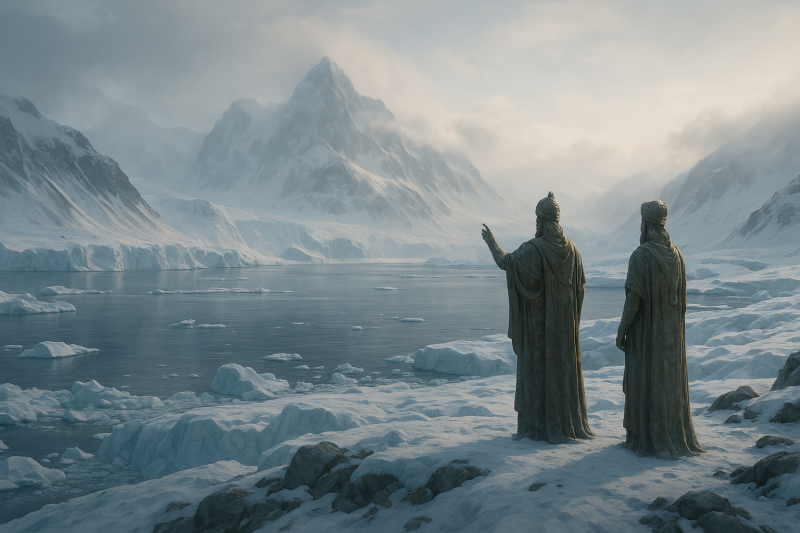
For over a century, scholars have studied the Sumerian world in search of clues about humanity’s earliest stories of origins and contact. Most breakthroughs have come from Mesopotamia itself, through well-known tablets describing the gods descending from the heavens, imparting knowledge, and establishing the first cities. Yet a new wave of translations is widening the lens. Recently examined fragments hint at something far beyond the traditional narrative, pointing not east or north, but toward a frozen land in the far south.
The emergence of these references is changing the conversation. They describe a remote region where sky-beings arrived and established a temporary outpost, a place marked by never-ending cold, distant waters, and “the land of the white horizon.” For decades such lines were treated as metaphor or mistranslation, but new linguistic work suggests the Sumerians may have been geographically specific rather than poetic. When placed alongside modern discoveries in Antarctica, the parallels have become difficult to ignore.
The significance of this shift lies not only in what the tablets describe, but in how they describe it. The texts speak of a descent route that did not pass directly into Mesopotamia, but first made contact in the far southern reaches of the world. They mention “the realm where the waters freeze upon themselves” and “the place where the sky touches the white earth,” phrases that carry an unexpected resemblance to polar environments. The notion that ancient scribes could reference Antarctica seems improbable at first glance, yet the consistency of the wording across multiple fragments suggests a memory older than the written language itself.
What strengthens the case further is the growing dataset from modern polar exploration. Over the last several years, Antarctica has become a focal point for unusual discoveries. Ground-penetrating radar has revealed geometric structures beneath the ice, particularly in Wilkes Land, showing angles and patterns that do not occur naturally. Satellite imagery has shown straight segments and repeating forms deep under the ice sheet, and seismic readings have detected void-like chambers in regions previously dismissed as geologically simple. These findings have already pushed researchers to re-evaluate what may lie hidden below the continent’s vast glacial cover.
When the new Sumerian translations mention “the sealed halls of the southern snow” and “the entrance marked by the still stars,” the descriptive overlap strikes a nerve. The language is restrained, almost administrative, not mythic. It reads less like a legend of gods and more like an early attempt to document routes, landmarks, and places of importance. If these fragments do preserve memories from an earlier, possibly pre-literate civilization, then the southern land may have been real and significant. The convergence between the textual record and the emerging physical data from Antarctica invites questions that were unthinkable only a decade ago.
In many of the translated lines, the sky-beings travel first to this frozen land before arriving in the fertile river valleys of Sumer. This suggests a staging point or an intermediate base rather than a direct descent. Scholars have long been puzzled by the Sumerian insistence that the gods “came from across the great waters” rather than down from the sky alone. Until recently, this was interpreted as a symbolic image, but it becomes more literal when a southern approach is considered. If the earliest arrivals were first detected at the edge of a polar region, the descriptions make far more sense.
Another compelling piece of this puzzle is the recurring Sumerian term for the location, one that loosely translates to “the land beyond the turning waters.” Originally believed to be a reference to distant seas west of Mesopotamia, it now appears linguistically closer to the idea of waters circulating around a landmass, something that applies uniquely to the Southern Ocean. The Sumerians did not possess the technology to observe global currents, yet their terminology corresponds remarkably well to the modern understanding of the circumpolar flow that isolates Antarctica from warmer waters.
In the last two years, re-evaluations of these tablets have coincided with another phenomenon: increased reports of unidentified aerial activity in the far south. Observations near the Weddell Sea, where silent metallic objects have been seen traveling at high speeds and performing maneuvers that defy conventional physics, have been documented by researchers, contractors, and military observers. These sightings have been dismissed by some, but the consistency across accounts has been difficult to ignore. The objects appear in coordinated patterns, often in proximity to regions where unusual magnetic fluctuations are detected.
These magnetic shifts form another link between the ancient narrative and the modern data. Some of the new Sumerian translations describe the southern realm as a place where “the sky vibrates” and “the earth hums beneath.” Although metaphorical interpretations exist, the terminology aligns strikingly with measurable anomalies beneath the Antarctic ice, particularly near Wilkes Land. Recent geophysical studies identified irregular magnetic signatures in the same region, unlike anything recorded elsewhere on the continent. These readings intensify during periods of increased UAP activity, suggesting a correlation between modern phenomena and ancient descriptions that reference a similar energetic environment.
Taken alone, each of these elements could still be explained through coincidence or misinterpretation. Ancient texts often reach for symbolism, and environmental data in remote regions can be ambiguous. Yet when the pieces are placed together—a frozen southern realm mentioned in the earliest known writing system, modern radar detecting geometric structures under Antarctic ice, recurring UAP activity near the same coordinates, and magnetic anomalies matching the descriptions—the collective picture becomes difficult to dismiss.
This does not mean the Sumerians visited Antarctica, nor that the continent once held a thriving civilization visible on the surface. Instead, the emerging interpretation suggests the Sumerians were preserving inherited knowledge, memories from a culture older than themselves. They wrote of gods, but behind the metaphors there may be historical recollections of encounters with advanced beings in places far beyond Mesopotamia. The frozen southern land could have been a waypoint, a base, or a region of early contact long before recorded history shaped the world we know.
As more fragments are translated, a clearer pattern is forming. The Sumerians appear to have known of a distant polar region, one that held significance in their cosmology and in the stories of origins they inherited. With modern evidence revealing structures below the Antarctic ice and unusual activity above it, the bridge between ancient memory and contemporary discovery is narrowing.
The story of the Sumerian Ice Gods is no longer a mythic curiosity. It is becoming a point of convergence between archaeology, linguistics, geology, and the ongoing global conversation about unidentified phenomena. Antarctica may hold answers not only about Earth’s geological past, but about the earliest chapters of human contact history.
What the Sumerians recorded may have been a fragment of a larger truth. And as new data emerges from the polar regions, that truth may be closer than anyone expected.
Add comment
Comments