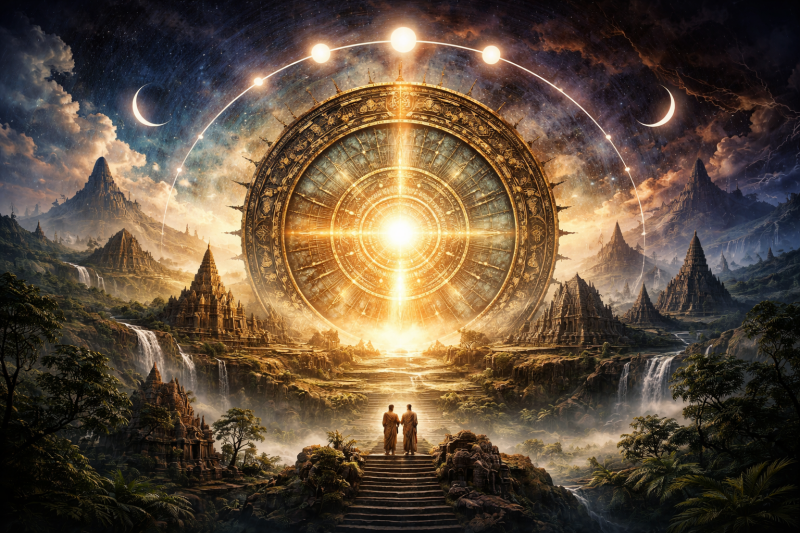
For most of recorded history, time has been treated as a line. A beginning, a middle, an end. Progress as direction, civilization as ascent. Yet beneath this modern assumption lies an older structure, one that refuses to disappear, even after centuries of dismissal.
In ancient Indian cosmology, time was never linear. It was cyclical. Vast, mechanical, indifferent to human narratives of advancement. According to these traditions, the world moves through repeating ages, rising and collapsing in patterned intervals, returning again and again to its point of origin.
This was not framed as philosophy or metaphor. It was presented as structure.
The ancient texts describe four recurring world ages, each defined by the state of human consciousness, social order, and alignment with natural law. The sequence begins with a high state of coherence, followed by gradual degradation, fragmentation, and finally collapse. When the cycle completes, the process resets, not forward, but back to the beginning.
What matters is not the mythology. What matters is the recurrence.
Across these traditions, the cycle is not singular. It is said to have unfolded multiple times already, entire worlds rising and falling before the current one. Civilization, in this view, is not unique. It is iterative.
The final age in the cycle is always marked by the same features. Social disintegration, loss of shared meaning, confusion of values, technological acceleration without wisdom, and an obsession with material power. Knowledge fragments, institutions hollow out, and truth becomes unstable. The world does not end in fire or flood. It ends in noise.
This description is uncomfortably precise.
What was once dismissed as ancient cosmology now echoes through modern analysis. Systems collapse faster than they can be repaired. Technological capacity outpaces ethical frameworks. Information multiplies while coherence declines. Identity fractures into endless subcategories. Authority dissolves, then reasserts itself in distorted forms.
The pattern is not symbolic. It is structural.
Ancient observers did not predict dates. They mapped phases. They described timing as consequence, not prophecy. When imbalance reaches a certain threshold, the cycle does not negotiate. It resets.
What is resurfacing now is not belief in ancient ages, but recognition of pattern. The same structural markers that defined previous transitions are appearing simultaneously across culture, economics, technology, and psychology. This convergence is why the idea of a new age returning to the beginning feels less speculative and more inevitable.
The language has changed. The structure has not.
Modern culture speaks of singularity, collapse, reset, great transitions. Ancient culture spoke of cycles completing and beginning again. Different words, same architecture.
The question is not whether humanity is advancing or regressing. That framing belongs to linear time. The real question is where we are within the cycle, and what happens when the loop closes.
Because cycles do not announce themselves. They reveal themselves only when the markers align.
And right now, too many markers are aligning.
This investigation does not end here. It cannot. The deeper structure, the timing logic, and the implications of previous cycles remain unresolved, deliberately so.
Those who assume history moves forward will miss what is happening.
Those who recognize the loop will understand why the world feels both new and ancient at the same time.
This investigation is ongoing. Paid readers follow the full timeline, connections, and updates as they emerge.