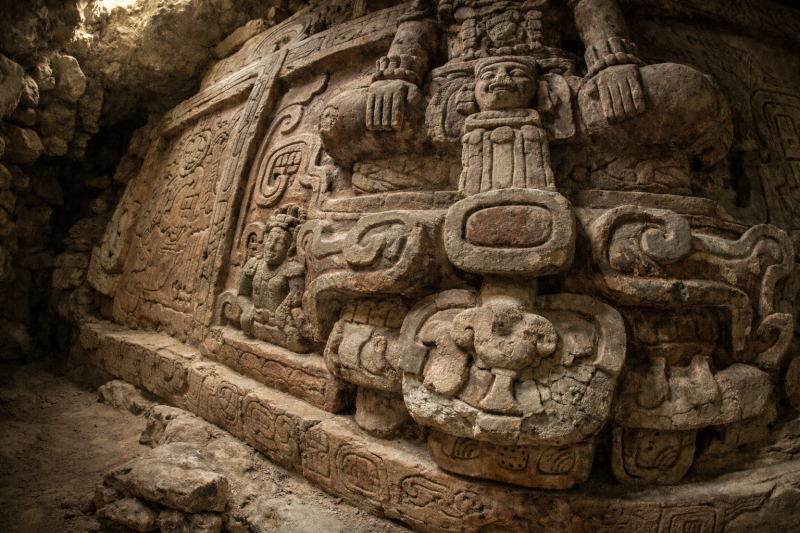
Step inside almost any ancient temple and the first thing you notice is what’s missing. There are no instructions, no explanations, no clear narratives meant for the uninitiated. Instead, there are walls of symbols, figures frozen in stone, and chambers designed to restrict light, sound, and access. These were not spaces built for the masses. They were built for continuity.
Across Egypt, Mesoamerica, and the ancient Near East, temples appear less like places of daily ritual and more like sealed containers of memory. Knowledge was not displayed openly, it was encoded, layered, and placed deep inside stone structures designed to survive time, climate, and cultural collapse.
This architectural pattern repeats across civilizations that supposedly had no contact. Inner chambers. Hieroglyphs without keys. Statues positioned in shadow. Reliefs carved with mathematical precision. These were not decorative choices. They were defensive ones.
What survives collapse is never loud. It is dense, symbolic, and hard to access.
Modern archaeology often treats these interiors as ceremonial or symbolic, but that assumption avoids a deeper question. Why invest such effort in preserving complexity if the message was purely spiritual? Why encode information in ways that only later technologies or perspectives can even recognize?
Now, fragments of that buried knowledge are resurfacing. Advanced dating challenges timelines. Digital analysis reveals geometric and astronomical precision. Disclosure narratives are shifting from ridicule to quiet acknowledgment. The pattern feels familiar, not new discovery, but re-entry.
History may not be linear. It may be cyclical, with knowledge intentionally hidden during unstable phases and reactivated when conditions allow. Temples were not the beginning of stories. They were vaults, waiting.
What we are witnessing today may not be progress, but recall.