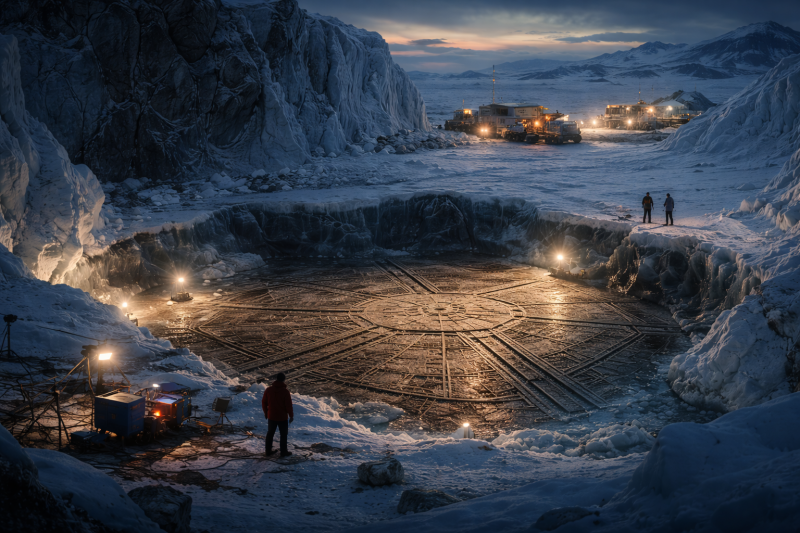
For decades, Antarctica has been framed as a frozen blank space, a continent defined by ice, isolation, and scientific neutrality. That narrative is beginning to fracture. Recent analysis of high-resolution sub-ice radar and satellite data has revealed geometric formations beneath the East Antarctic ice sheet that do not easily conform to known natural processes. The question is no longer whether anomalies exist, but why this data is surfacing now.
The patterns identified beneath the ice display angular symmetry and large-scale organization. These are not the chaotic formations typically produced by glacial movement or tectonic activity. While scientists remain cautious in their language, the geometry itself presents a problem. Nature produces repetition, but rarely precision at this scale without an underlying structure.
This is where timing becomes critical. The emergence of these findings coincides with a broader shift in how previously classified or marginalized information is handled. Across multiple domains, from UAP disclosure to archaeological reassessments, institutions appear more willing to acknowledge anomalies without fully explaining them. Antarctica is now entering that same space of quiet admission.
Historically, moments like this follow a pattern. Data becomes available before interpretation is allowed. Signals appear before narratives adjust. This staggered process has occurred repeatedly during past disclosure cycles, particularly when new technology exposes realities that older models cannot absorb. Advanced sensing tools do not create anomalies; they reveal them.
The Polar Nexus framework views Antarctica not as an isolated mystery, but as part of a global system. Similar geometric and subterranean features have been documented near the Andes, across parts of South America, and beneath ancient megalithic sites worldwide. These locations share one trait: they were once considered marginal or symbolic, until evidence forced reevaluation.
Some researchers have begun revisiting alternative explanatory models, not as conclusions, but as lenses. The Anunnaki hypothesis, pre-diluvian civilizational theory, and Hollow Earth traditions all attempt to explain sudden leaps in ancient knowledge and infrastructure. Whether these models are ultimately validated is secondary. Their relevance lies in the fact that conventional explanations increasingly fail to account for the scale and coordination implied by the data.
Antarctica’s role in this discussion is especially sensitive. The continent has long been protected by international treaties that limit exploration and development. While these agreements are publicly framed around preservation, they also ensure that access remains tightly controlled. As technology advances, maintaining a narrative of emptiness becomes more difficult.
Disclosure rarely arrives as a single revelation. It unfolds through inconsistencies, quiet confirmations, and the erosion of old assumptions. What we are witnessing now fits that pattern precisely. The ice is not suddenly revealing secrets. Our ability to see them has reached a threshold.
If Antarctica is not empty, then history is incomplete. And if history is incomplete, then the story of human civilization requires revision. This investigation follows those implications carefully, without spectacle, and without premature conclusions. This is not a closed case. It is an unfolding one. This investigation is ongoing. Paid readers follow the full timeline, connections, and updates as they emerge.